
Day trips from Llandudno: Snowdonia, Conwy Castle and beyond
- Jet R.

- 2 days ago
- 9 min read
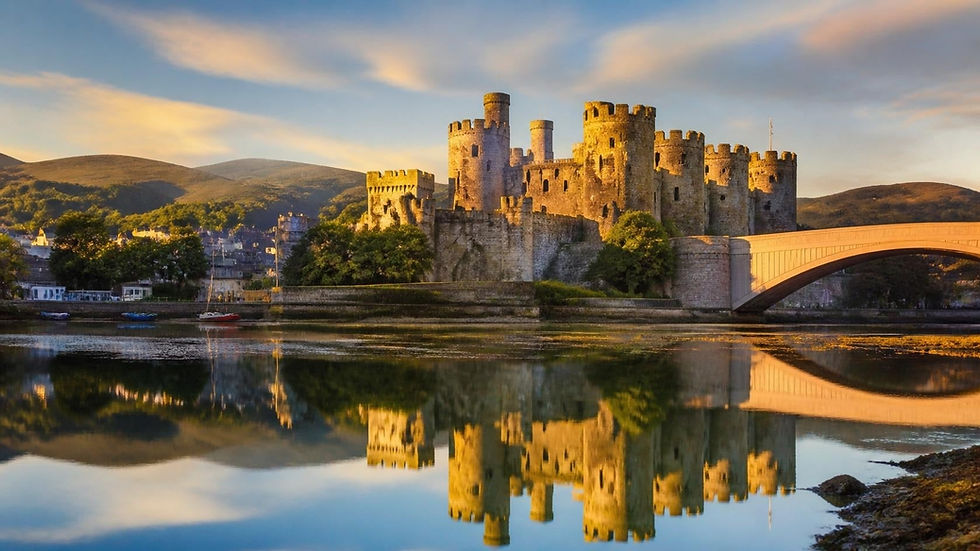
One of the quiet pleasures of choosing Llandudno as your base in North Wales is the discovery, usually sometime on the first morning, of just how much lies within easy reach.
The town itself is magnificent. The promenade, the pier, the Great Orme, the Victorian streets- there is more than enough here to fill a stay without ever leaving the peninsula. But North Wales has a habit of drawing you outward. The mountains appear on the horizon, and you find yourself planning a drive. The castle you noticed on the map turns out to be a short journey away. The island you can see across the water begins to seem entirely reachable.
Llandudno sits at the heart of one of the richest concentrations of landscapes, heritage, and natural beauty in the whole of Britain. Within an hour in any direction, often considerably less, you can be standing beneath a medieval fortress, climbing a mountain pass, walking the shoreline of a glacial lake, or crossing the Menai Strait to the Isle of Anglesey.
This is the day trips guide you need. Keep it handy. You'll use it more than once.
Conwy: the medieval walled town (20 minutes)
Start close to home, because close to home in this case means one of the finest medieval towns in Europe.

Conwy is just 4 miles west of Llandudno, a 20-minute drive or a straightforward cycle along the coastal route, and it rewards every visit with the particular quality of a place that has survived largely intact from the 13th century. The town walls, the castle, and the street plan within are all original, all extraordinary, and all still in daily use.
Conwy Castle
Conwy Castle was built between 1283 and 1289 under the instruction of Edward I as part of his campaign to consolidate English control over Wales. The architect was James of St George, the greatest military architect of medieval Europe, and the result is considered one of the finest examples of late 13th-century castle construction anywhere in the world. It is a UNESCO World Heritage Site, designated alongside the other Edwardian castles of North Wales.
Walk the battlements on a clear day, and the views are extraordinary: the estuary, the mountains of Snowdonia, and the town walls radiating outward from the castle in a circuit that is very nearly complete after seven centuries. It is difficult to stand up here and remain entirely unmoved.
Practical details: Allow two to three hours for the castle and walls. Entry charges apply. Cadw members enter free.
The town walls and Smallest House in Britain
The medieval town walls of Conwy extend for three-quarters of a mile around the historic centre, punctuated by 21 towers that are still walkable in their entirety. It is one of the most complete circuits of medieval town walls surviving anywhere in Britain, and the views from the wall walk alternate between the mountains, the estuary, and the intimate rooftop geography of the town below.
On the quayside, look out for the Smallest House in Great Britain - a vivid red terraced dwelling of almost impossible narrowness that has been a Conwy fixture since the 16th century and continues to attract visitors with entirely justifiable curiosity.
Insider tip: Cross the Conwy Suspension Bridge, built by Thomas Telford in 1826 and one of the earliest suspension bridges in the world, for a pedestrian route into the town centre with views of the castle reflected in the estuary. There is nothing quite like it.
Snowdonia National Park: the big day out (45 minutes)
If you do one day trip from Llandudno, make it Snowdonia. Not because it is the nearest or the easiest, but because it is the most extraordinary.
Snowdonia National Park covers 823 square miles of mountain, forest, lake, and moorland, a landscape of genuine wildness and scale that feels genuinely remote even though its nearest point is less than 30 miles from Llandudno. It is the third most visited national park in the United Kingdom, and the reasons are not difficult to identify.
Mount Snowdon
Snowdon - or Yr Wyddfa in Welsh, meaning 'the burial place'- is the highest mountain in Wales and England at 1,085 metres. On a clear day the summit offers views across to Ireland, the Isle of Man, and the coast of Scotland, a panorama of quite staggering scope that rewards every metre of the climb.
There are six walking routes to the summit, ranging from the popular Llanberis Path (the longest but most accessible) to the more demanding Crib Goch ridge route for experienced hillwalkers who want one of the finest mountain traverses in Britain. The Snowdon Mountain Railway, running from Llanberis to the summit since 1896, offers an alternative for those who prefer their mountain views without the exertion, a Victorian rack-and-pinion railway that is a remarkable piece of engineering in its own right.
Practical details: Allow a full day for walking Snowdon. The Llanberis Path takes approximately five to six hours return for most walkers. Book the Mountain Railway in advance during summer; it fills quickly. Check the weather forecast carefully; summit conditions can change rapidly regardless of conditions in the valley.
Betws-y-Coed
For a gentler introduction to Snowdonia, Betws-y-Coed is the natural starting point. The village sits at the confluence of three rivers in the Conwy Valley, surrounded by ancient oakwood forest, and serves as the informal gateway to the national park. The waterfalls, particularly Swallow Falls on the Afon Llugwy, are spectacular after rain, and the village itself is well-equipped with cafés, independent shops, and outdoor gear suppliers.
The Conwy Valley railway line connects Llandudno Junction to Betws-y-Coed in approximately 40 minutes, one of the most scenic rail journeys in Wales, following the river south through gradually deepening countryside. It is an option well worth considering on a day when the weather makes driving in the mountains feel ambitious.
Llyn Gwynant and the mountain lakes
Snowdonia's lakes are a revelation. Llyn Gwynant, Llyn Padarn, and Llyn Peris each offer a quality of mountain lake scenery that has few equals in Britain, still water reflecting steep-sided ridges, the sense of geological time made visible in every contour. The drive from Llanberis over the Llanberis Pass to Pen y Pass and down to Gwynant is among the finest mountain road journeys in the UK, and the layby at Llyn Gwynant is one of the most photographed spots in Wales.
Anglesey: the island escape (40 minutes)
Cross the Menai Strait - by Thomas Telford's suspension bridge of 1826 or Robert Stephenson's Britannia Bridge beside it, and you arrive on Anglesey, an island of an entirely different character to the mainland behind you.
Where Snowdonia is dramatic and vertical, Anglesey is open and horizontal, low-lying farmland, ancient field systems, and a coastline of extraordinary variety stretching for 125 miles around the island's perimeter. It has its own distinct quality, its own Welsh-speaking culture, and its own remarkable heritage.
Beaumaris Castle
Beaumaris Castle, on the eastern coast of Anglesey, is another of Edward I's great fortresses and the last to be built in his Welsh campaign. Where Conwy was built for speed, Beaumaris was designed for perfection, a concentric castle of precise symmetry that represents the highest achievement of medieval military architecture. It was never quite finished, which lends it a curious quality of suspended ambition, but what was built is breathtaking.
Like Conwy, it is a UNESCO World Heritage Site. Allow at least two hours, and consider combining it with a walk along the Anglesey coastal path, which passes through Beaumaris with lovely estuary views back towards the mainland.
The Anglesey Coastal Path and hidden beaches
The Anglesey Coastal Path extends for 125 miles around the entire island and offers some of the most varied coastal walking in Wales. You need not walk the whole thing to benefit; short sections around Rhosneigr, Porth Dafarch, and the South Stack Lighthouse on Holy Island each offer outstanding scenery within an hour's driving time from the bridge.
The beaches of Anglesey are among the finest in Wales, wide, clean, and significantly less crowded than comparable stretches of the English coast. Llanddwyn Island near Newborough, accessible at low tide, is particularly remarkable, an almost impossibly romantic spit of land with a lighthouse, the ruins of a medieval chapel, and views of the Llŷn Peninsula and Snowdonia that belong on a postcard.
The Llŷn Peninsula: wild Wales at its finest (1 hour)
Drive south-west from Llandudno along the North Wales coast and turn onto the Llŷn Peninsula, a narrow finger of land pointing south-west into the Irish Sea, and the quality of the landscape changes almost immediately.
The Llŷn is remote, unhurried, and deeply Welsh in character. The language is spoken here as a living everyday tongue rather than a ceremonial one, the villages are small and unaffected by tourism, and the scenery along the peninsula's northern and southern coasts is as wild and beautiful as anything in Wales.
Abersoch on the southern coast is the most visitor-facing town on the peninsula, a sailing and surfing hub with excellent beaches and a lively café culture. Further west, Aberdaron at the tip of the peninsula has the quality of a place at the edge of the world, a single village street, a medieval church, and the sea on three sides. From here the twin islands of Bardsey are clearly visible, a medieval pilgrimage site known as the 'island of 20,000 saints', accessible by boat from Aberdaron in suitable conditions.
The drive out and back along the peninsula takes a full day done properly, and it is one of the most rewarding in North Wales.
Caernarfon: castle, town and culture (45 minutes)

Caernarfon is the third of Edward I's great North Wales fortresses and, if anything, the most dramatic of all. The town and castle sit at the mouth of the Menai Strait, the castle's distinctive polygonal towers rising from the water's edge in a configuration that has defined this corner of North Wales for seven centuries.
Caernarfon Castle is the largest of the Edwardian castles in Wales and one of the most visited heritage sites in the country. It served as the venue for the investiture of the Prince of Wales in both 1911 and 1969, ceremonies that brought global attention to a building that had been remarkable for 700 years before either event.
The town itself is worth time: the medieval town walls survive in good condition, the independent shops and restaurants of Pool Street and Castle Square have a genuinely local character, and the waterfront setting is outstanding. The Welsh Highland Railway runs from Caernarfon southward through Snowdonia to Porthmadog, a heritage steam railway journey through extraordinary scenery that is well worth taking if time allows.
Bodnant Garden: beauty without the exertion (30 minutes)
Not every day trip needs to involve battlements or mountain passes, and Bodnant Garden in the Conwy Valley provides one of the most civilised alternatives in North Wales.
Managed by the National Trust, Bodnant is one of the great gardens of Britain, 80 acres of formal terracing, woodland gardens, and plant collections laid out against a backdrop of Snowdonia that makes every view feel like a landscape painting. It is spectacular in spring when the rhododendrons and azaleas are in full bloom, but it has a quiet beauty in every season, and the laburnum arch, one of the longest in the world, is one of those garden features that stops even the most garden-indifferent visitor in their tracks.
Practical details: National Trust members enter free. Allow three to four hours for a thorough visit. The café is excellent.
Planning your days out from Llandudno Great Escapes
A few practical notes that will make every day trip run more smoothly:
Start early. The most popular sites, Snowdon, Conwy Castle, and Caernarfon, are significantly more enjoyable before the mid-morning coach parties arrive. An early breakfast at the apartment and an 8 am departure changes the experience considerably.
Use the train where you can. The North Wales Coast Line connects Llandudno Junction to Conwy, Bangor, and Holyhead, with onward connections to the Llŷn and beyond. The Conwy Valley Line south to Betws-y-Coed is one of the most scenic rail journeys in Wales. Guests at James Court Apartments are particularly well placed for public transport; the free parking means the car stays safely on site while you travel by rail.
Allow more time than you think you'll need. North Wales has a habit of expanding. What looked like a two-hour visit to a castle becomes a half-day when you find yourself walking the town walls, stopping for lunch on the quayside, and realising you haven't seen the bridge yet. This is not a problem. It is the point.
Layer up for Snowdonia. Mountain weather in North Wales is variable and can change quickly. A good waterproof and an extra layer are the non-negotiables for any visit to the national park, regardless of what the forecast says when you leave Llandudno.
Your base for all of it
Llandudno Great Escapes places you within easy reach of everything in this guide.
James Court Apartments offer self-catering one and two-bedroom apartments in the heart of Llandudno, with free parking, excellent public transport links, and the kind of comfortable, flexible base that makes early starts and late returns equally painless. The beach is 0.3 miles from the door for the days when North Wales simply refuses to be improved upon.

Curzon Villa gives groups of up to 20 a luxurious private base with 10 bedrooms, 8 en-suite bathrooms, a hot tub, and a games room- everything a large group needs to decompress after a day in the mountains or a morning on the castle battlements.

Planning your North Wales itinerary? Browse our full collection of local guides, heritage posts, and seasonal travel tips on the Llandudno Great Escapes blog.


Comments